Jianguo Zhao
Department of Mechanical Engineering, Colorado State University
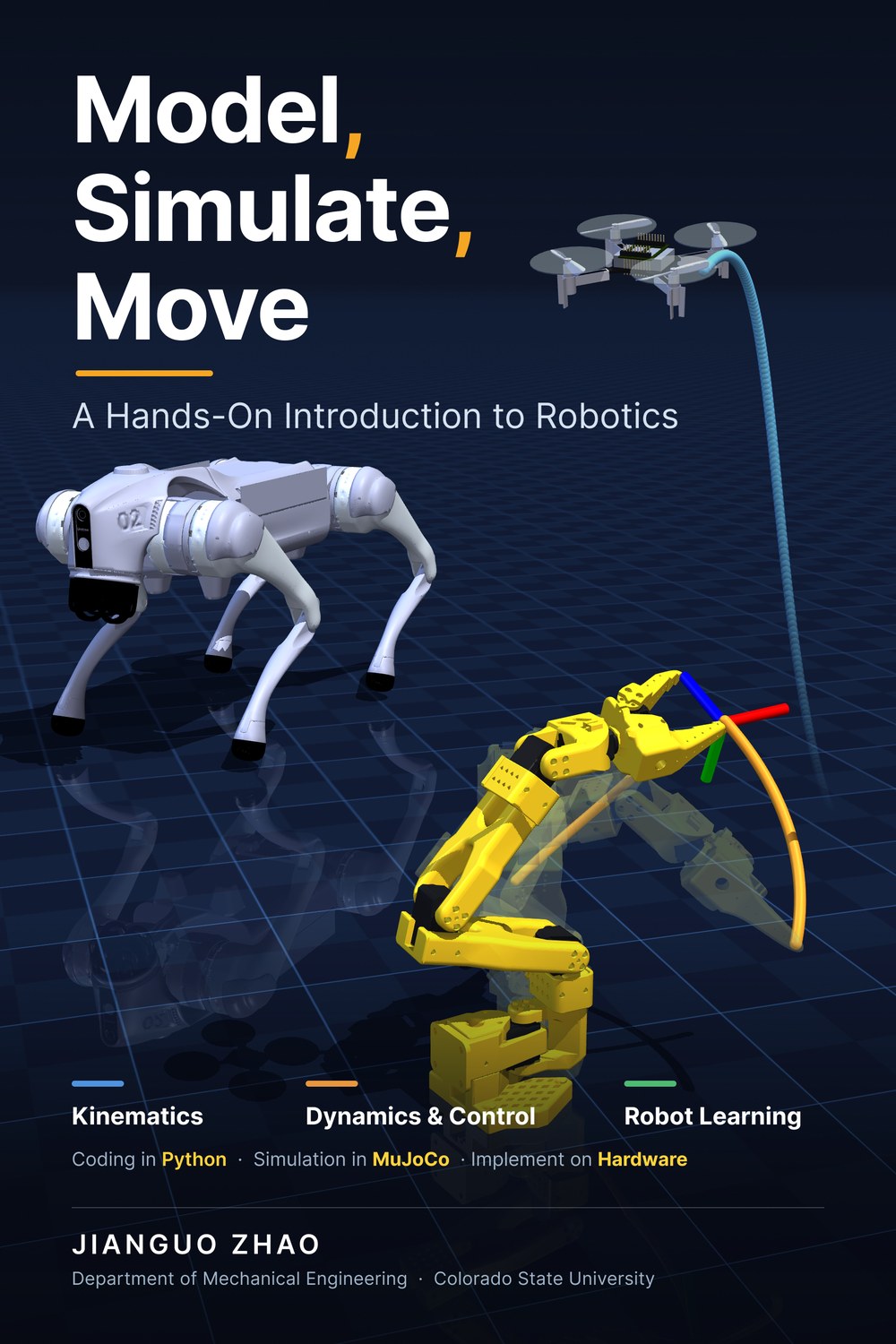
An online, interactive book. It is under active development, and new chapters are added as they are finished.
Why this book?
Most robotics textbooks teach the theory and leave the practice to the reader. This book tries to do both. It keeps the rigor expected of a robotics fundamentals text, and it takes every idea all the way to a robot that actually moves.
The title describes how each topic is learned:
Model. Describe the robot mathematically, derive its equations from first principles, and turn them into Python code.
Simulate. Test that code in MuJoCo on models of real robots before touching any hardware.
Move. Run the same code on real, affordable robots. Some you build yourself, such as a planar 2R arm; others you use as they are. Command the robot, measure what it actually does, and compare the result with what the theory predicted.
We start from the same foundations as traditional textbooks. Alongside the derivations, each chapter includes numerical implementations in Python for problems such as forward and inverse kinematics, the Jacobian, trajectory generation, and dynamics and control. MuJoCo then lets us study robots that would be hard to analyze by hand, such as complete arms and legged robots, by simulating their kinematics and dynamics directly.
What you will use
Python, with NumPy and Matplotlib, in Jupyter notebooks. Every chapter’s code can be run and modified.
MuJoCo, a free, open-source physics simulator, with open-source models of real robots.
Real hardware at two levels:
Kinematics. Smart serial-bus servo motors that are commanded by joint angle or speed. They are used to build a planar 2R arm and to control the open-source, low-cost SO-101 robot arm.
Dynamics and control. Quasi-direct-drive (QDD) actuators that are commanded by torque. These make it possible to implement dynamics-based controllers, such as computed-torque and impedance control.
How this book is organized
The book has three parts. Each part builds on the one before it.
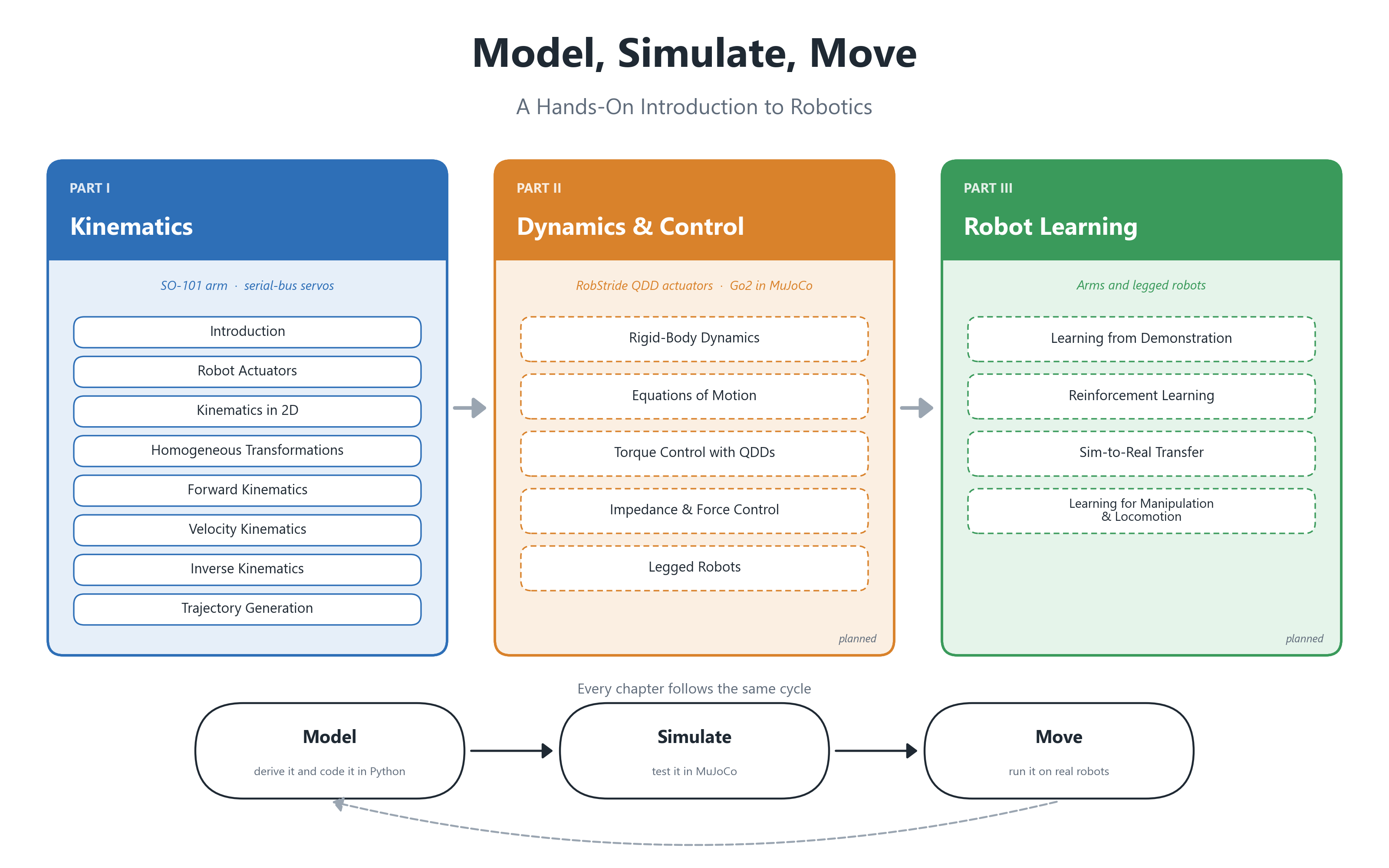
Part I: Kinematics
How a robot’s joints determine where its gripper is, how fast it moves, and how to plan its motion.
| # | Chapter | Status |
|---|---|---|
| 1 | Introduction (this page) | ✅ Published |
| 2 | Actuators for Robotics | ✅ Published |
| 3 | Kinematics in 2D | ✅ Published |
| 4 | Homogeneous Transformations | ✅ Published |
| 5 | Forward Position Kinematics | ✅ Published |
| 6 | Velocity Kinematics | ✅ Published |
| 7 | Inverse Kinematics | ✅ Published |
| 8 | Trajectory Generation | ✅ Published |
Part II: Dynamics and Control (planned)
How forces and torques produce motion, and how to control robots through torque rather than position: rigid-body dynamics, equations of motion, and model-based control. The hardware moves to torque-controlled QDD actuators, and the examples extend from arms to legged robots in simulation.
Part III: Robot Learning (planned)
How robots can learn skills from data: learning from demonstration, reinforcement learning in simulation, and transferring what is learned in simulation to real robots.
Hands-on labs
Each part comes with labs that put the chapters into practice on the hardware described above. The first labs, on software setup, Python, and motor control, are available in the Labs section of this book. More will be added as the corresponding chapters are published.
Who is this book for?
This book is written for undergraduate students who want to learn the basics of robotics and get hands-on experience with real robots. It is also a good fit for anyone else who wants to learn the fundamentals of robotics from the ground up. You will need some calculus, linear algebra, and basic programming. The book introduces the Python you need along the way.
It is not aimed at experienced researchers. If you are already comfortable with robotics fundamentals and want a more advanced or comprehensive treatment, we recommend Modern Robotics: Mechanics, Planning, and Control (Lynch and Park) or Robot Modeling and Control (Spong, Hutchinson, and Vidyasagar).
How to cite this book
If you use this book in your teaching or research, please cite it as:
Jianguo Zhao. Model, Simulate, Move: A Hands-On Introduction to Robotics. Online book, 2026. https://
jianguozhaorobotics .github .io /RoboticsBook/
BibTeX:
@misc{zhao2026modelsimulatemove,
  author       = {Jianguo Zhao},
  title        = {Model, Simulate, Move: A Hands-On Introduction to Robotics},
  year         = {2026},
  howpublished = {\url{https://jianguozhaorobotics.github.io/RoboticsBook/}},
  note         = {Online interactive book}
}Disclaimer
I designed this book: its outline, chapter structure, topics, and the examples and labs it covers are all mine, drawn from my experience teaching robotics. Working from that outline, Claude, an AI assistant developed by Anthropic, drafted the text and wrote the code under my direction. I check and revise the content and the code as I teach. Even so, errors may remain. If you find any mistakes or have suggestions, please contact me at Jianguo
Acknowledgments
The robot models on the cover come from MuJoCo Menagerie and the SO-101 project.